
Lovable Valuation Tests the Vibe-Coding Boom
 Vortixel
15 minutes read
Vortixel
15 minutes read
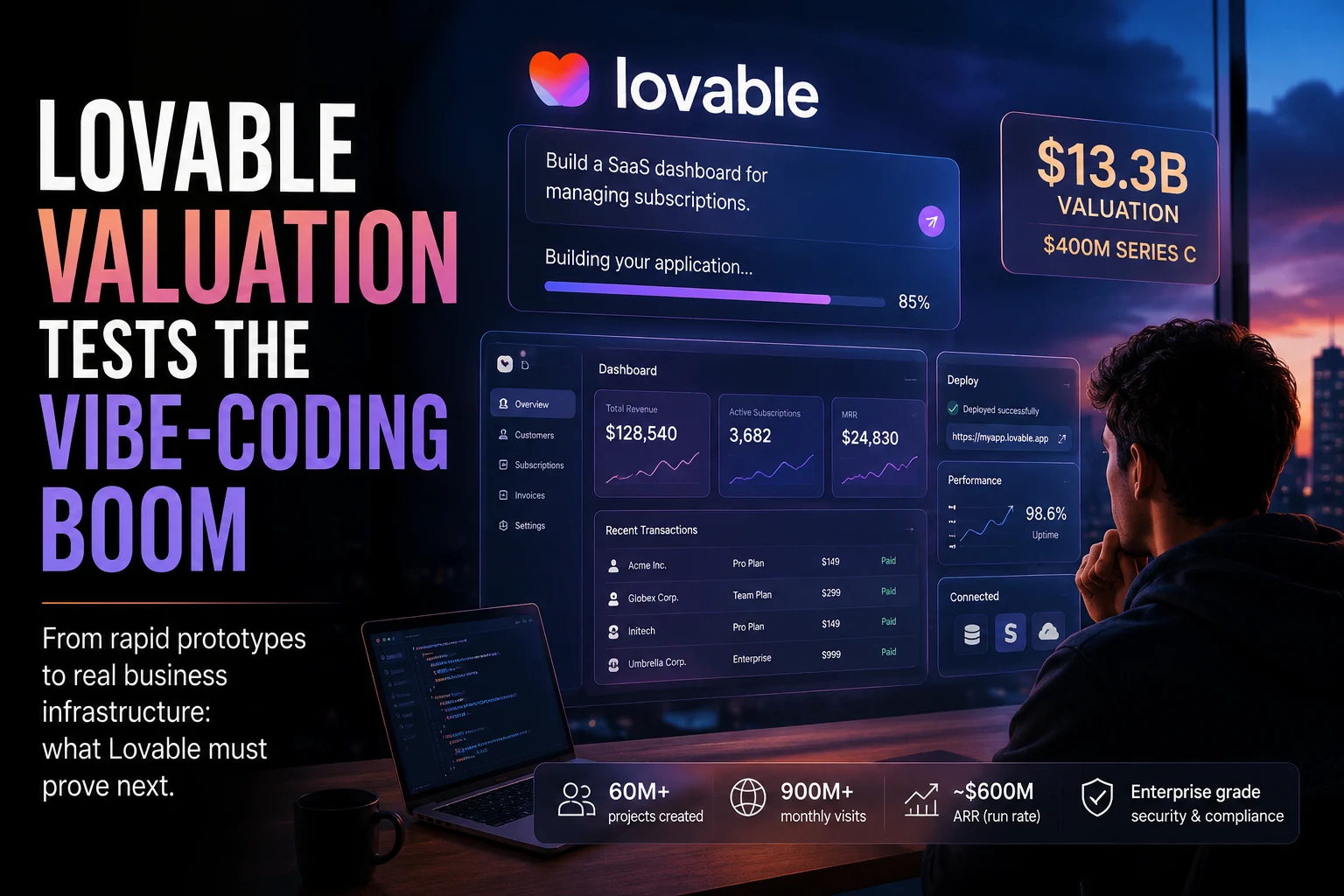
A $13.3 billion valuation can make almost any startup story sound finished. The funding arrives, the number gets attached to the company name, and the market moves on to the next AI business growing faster than seems reasonable. Lovable is more interesting precisely because its story is nowhere near finished. The Stockholm-based company has raised $400 million in Series C funding after turning natural-language software creation into one of the fastest-growing product categories of the AI era. Since launching in November 2024, more than 60 million projects have been created on the platform, while apps built with Lovable now attract more than 900 million visits each month. Those numbers make the Lovable valuation easier to understand. They do not make the next phase of the company any easier to execute.
The question facing Lovable is no longer whether people want to build software by describing what they want. That behavior has already escaped the experimental phase. The harder question is what happens after the magic trick becomes normal. Creating a working interface from a prompt can feel almost absurdly fast compared with traditional development, but startups are rarely rewarded forever for making the first five minutes impressive. The durable businesses are usually the ones that become useful during the next five years. Lovable has already shown that it can compress the distance between an idea and functioning software. Now it has to prove that convenience can become infrastructure.
Lovable Is Selling a Shorter Distance to Software
The easiest way to misunderstand Lovable is to describe it simply as an AI coding tool. Coding is certainly part of what the product does, but code generation is not necessarily the product users are buying. What they are buying is a shorter distance between intention and output. A founder can describe a customer dashboard, an internal tool, a marketplace, a landing page, or the early structure of a SaaS product and receive something tangible without beginning with a blank repository. Lovable can handle front-end interfaces as well as elements such as databases, authentication, integrations, deployment, and application infrastructure. That changes the experience from asking an AI assistant for isolated snippets of code to asking a system to participate in assembling the product itself.
That distinction matters because the addressable market becomes much larger once software creation stops being framed as an activity reserved for software engineers. The potential user is suddenly the designer who understands a customer problem but cannot build the application, the marketer who wants an internal workflow without waiting for an engineering sprint, the consultant who sees the same repetitive pain across clients, or the founder who has enough conviction to test an idea but not enough capital to hire an initial product team. Professional developers remain part of the market, but they no longer define its outer boundary.
This may be the most important part of the Lovable story. AI coding is often discussed as if the primary economic event is engineers becoming faster. There is another possibility: more people become capable of producing software at all. Those are very different markets. Productivity software helps an existing worker complete more work. Market-expanding software creates new producers. If Lovable ultimately belongs in the second category, its opportunity is much larger than replacing a few hours of manual coding.
Vibe Coding Works Because the First Result Arrives Fast
Software development has historically contained a brutal delay between having an idea and experiencing it. Even a reasonably simple product requires decisions about frameworks, environments, data models, interfaces, deployment, authentication, and dozens of details that have nothing to do with the original insight. Skilled developers learn to navigate that complexity, but the complexity does not disappear. Lovable attacks the delay itself. A user describes an outcome, watches a version appear, responds to it, and continues iterating.
That feedback loop is unusually powerful from a growth perspective because the product demonstrates its value before the user has invested much effort. Traditional professional software frequently asks customers to configure a workspace, migrate data, invite colleagues, or learn a new workflow before the payoff becomes obvious. AI builders reverse that relationship. The payoff arrives first. A page exists. A button works. A rough product suddenly looks real. The user becomes emotionally invested before encountering the deeper limitations.
This also creates natural distribution. The artifact generated by the product can become an advertisement for the product. Someone builds a small tool, shares it with colleagues, posts it online, launches it to customers, or turns it into a business. Every visible result can trigger the same question from another potential user: how did you build that so quickly? Lovable says more than 60 million projects have been created on its platform and that Lovable-built applications receive more than 900 million visits per month. Even allowing for the enormous range in what qualifies as a project, that is a meaningful distribution surface.
The Revenue Makes This More Than an AI Demo
Viral usage can produce spectacular charts while producing a mediocre business. AI startups have an additional problem because curious users can consume expensive inference without developing much willingness to pay. Lovable has moved far enough beyond that stage that its revenue deserves attention. The company surpassed a $500 million annualized revenue run rate by June 2026, according to figures it shared at the time, after having reached roughly $400 million earlier in the year. The latest funding coverage puts the run rate on course to approach $600 million. That pace does not tell us what long-term retention or margins will eventually look like, but it makes one thing clear: Lovable has found substantial paid demand.
Its monetization model also hints at where the company wants to sit in the stack. Lovable prices its main plans around credits rather than conventional per-seat software licensing, and its current product increasingly combines building, hosting, backend usage, and AI functionality within the same usage system. Workspaces can include unlimited members while consumption determines how quickly credits are used. That makes Lovable less like a static design utility and more like a metered production environment. If customers continue running applications on the platform after building them, the economic relationship becomes significantly more interesting than a subscription people keep only while prototyping.
This is where the startup begins to look less like a clever wrapper around a model. The initial prompt may acquire the customer, but hosting, collaboration, integrations, backend infrastructure, deployment, security, and ongoing application usage can deepen the relationship. The more of that lifecycle Lovable owns, the less its value depends on merely generating better React code than someone else.
The $13.3 Billion Question Is Really About Category Size
Lovable’s latest round was led by Menlo Ventures and co-led by the Scaleup Europe Fund managed by EQT, with additional investors spanning Europe, Latin America, Asia, and the United States. The $400 million Series C values the company at $13.3 billion, roughly double the $6.6 billion valuation attached to its $330 million Series B in December 2025. A valuation moving that quickly naturally invites the simplest possible debate: too high or justified? That framing is not particularly useful. Venture valuations are bets on an outcome distribution, not certificates proving what a company is worth forever.
The more useful question is what kind of company Lovable must become for that valuation to look ordinary several years from now. It probably cannot remain merely the easiest place to generate an attractive MVP. Tools at that layer can become enormously popular, but the feature surface is exposed to rapid imitation. Foundation models improve. Competitors copy workflows. Hosting platforms add agents. Design products generate code. Coding environments become conversational. What looks like a standalone category one year can become a checkbox inside a much larger platform the next.
For the valuation to age well, Lovable is effectively being asked to capture a meaningful portion of a much larger transition: software creation becoming accessible to anyone capable of clearly describing a problem. That would place the company somewhere between a development environment, a cloud platform, a collaborative workspace, and perhaps eventually an operating layer for small digital businesses. Seen through that lens, investors are not paying for a prompt box. They are paying for the possibility that the prompt box becomes the front door to a new software economy.
The Most Interesting Users May Not Be Developers
Developer adoption is useful validation for an AI coding product, but non-developer adoption could produce the more consequential market shift. Lovable has said that more than half of respondents in one of its user surveys were building a business, while another quarter had side projects they hoped to monetize. The company only introduced the relevant payments functionality in February 2026, so its own commerce data remains early, but it has already reported users reaching meaningful revenue milestones with products created on the platform. Those are company-provided figures and should be treated accordingly, yet the direction is notable.
For years, startup formation has been partly constrained by the cost of translating domain knowledge into software. Someone might understand restaurant operations, freight logistics, fitness coaching, property management, or legal administration extremely well and still be unable to test a software idea without recruiting a technical co-founder or paying developers. Vibe coding weakens that constraint. It does not eliminate engineering, but it changes when engineering becomes necessary.
That timing difference can reshape startup economics. Instead of hiring a full team before discovering whether customers care, a founder can potentially reach the first useful prototype, first user interviews, and perhaps even first paying customers with dramatically less technical overhead. The engineer does not disappear. Engineering effort can move later in the sequence, closer to the point where the product has demonstrated enough demand to justify deeper investment.
For founders, that is a much bigger development than “AI writes code faster.” It changes what can be tested, who can test it, and how cheaply failure can happen. Cheaper failure tends to produce more experiments. More experiments can produce more companies. If Lovable becomes the environment where a meaningful share of those experiments start, its strategic position becomes much harder to dismiss.
But Easy Creation Is Not Yet a Moat
This is where Upxel’s skepticism kicks in. One of the most dangerous moments for an AI startup is when strong product-market fit gets confused with permanent defensibility. Lovable clearly has momentum. Momentum and moat are not synonyms.
The underlying language models available to software companies continue to improve, which means capabilities that once required elaborate product engineering can become easier for competitors to reproduce. A model provider can move upward into application building. A cloud company can integrate generation directly into deployment. An existing developer platform can combine its installed base with an agentic interface. A design platform can turn prototypes into working applications. Each of those competitors enters from a different direction, but all can compress the space Lovable currently occupies.
Lovable therefore needs defensibility above the model. Product taste can be part of it. A deeply refined workflow matters because users do not experience raw model benchmarks; they experience whether the system understands what they are trying to build. Integrations matter because a generated interface becomes more useful when databases, payments, authentication, APIs, and deployment work without forcing the user into another stack. Collaboration matters because solo experimentation becomes organizational infrastructure only when teams can safely work together. Distribution matters because a company with enough builders can become the default starting point even when several alternatives are technically capable.
There is also operational context. Lovable has previously described engineering work required to make services such as Supabase behave reliably inside an AI-driven building workflow, including orchestration and translation layers above external APIs. That kind of integration work is less glamorous than the generation demo, but it may be closer to where practical product defensibility is built. Models can generate code. Users still need the rest of the system to behave coherently.
The Platform Risk Is Impossible to Ignore
Every application-layer AI company eventually faces a version of the same uncomfortable question: what happens when the model provider ships your product?
For Lovable, the threat is unusually visible. OpenAI, Anthropic, Google, Microsoft, and other large technology companies have the models, distribution, infrastructure, and capital to make increasingly sophisticated software creation native to their existing products. Meanwhile, specialized competitors such as Replit approach the same opportunity from established development environments. The pressure does not require one competitor to clone Lovable perfectly. It only requires enough of the underlying capability to become commonplace that customers stop valuing the generation layer on its own.
This is why Lovable’s movement toward a broader business-building platform is strategically important. If users arrive to generate code and leave with a repository, the switching cost can remain low. If they build, deploy, collaborate, host, secure, operate, and monetize through the same environment, the relationship becomes deeper. Lovable has already been expanding beyond generation into areas including production infrastructure, enterprise controls, security tooling, and application operations. Its current plans include business and enterprise features while its credit system increasingly spans both application creation and runtime usage.
The difference sounds subtle, but it defines two very different companies. One helps you make software. The other becomes a place where software businesses live.
Prototype Magic Meets Production Reality
There is another obstacle that no valuation can skip: production software is unforgiving. A prototype needs to impress a founder. A real application needs to survive customers.
The difficulty rises quickly once software contains sensitive data, payments, permissions, complex business logic, integrations, concurrent users, regulatory obligations, or years of accumulated changes. Authentication must behave correctly. Database permissions need to be restrictive for the right reasons. Dependencies require maintenance. Bugs need to be reproducible. Infrastructure must survive traffic spikes. Teams need to understand code they did not manually author. A feature that looked perfect in a generated preview can become expensive when nobody understands why changing one component quietly breaks three others.
Research on vibe coding reflects that divide. A 2026 multivocal literature review covering peer-reviewed and practitioner evidence found the strongest support around prototyping and user-interface work, while evidence remained weaker for long-term maintainability, production environments, data-intensive systems, and safety-critical applications. The researchers also describe vibe coding less as a single magical prompt and more as an iterative cycle of generation, evaluation, and revision. That is important because the future of AI development probably looks less like “the machine writes everything” and more like humans shifting from writing each line toward specifying, supervising, testing, and validating increasingly autonomous systems.
Lovable appears aware that security is part of this transition rather than an optional enterprise feature. The company has built automated security checks, maintains certifications including ISO 27001 and SOC 2-related controls, and has added tooling around areas such as vulnerability detection and penetration testing. Those investments are strategically necessary. The more Lovable succeeds at attracting people without deep engineering backgrounds, the more responsibility the product itself must assume for preventing users from unknowingly creating dangerous systems.
This may become one of the defining product battles in vibe coding. Generating software that looks finished is becoming cheap. Generating software that behaves safely after twelve months of real-world changes is a much harder problem.
Lovable Could Change the Shape of Early Startup Teams
There is a tendency to discuss AI coding primarily through the lens of engineering employment. Startup founders should probably pay just as much attention to organizational design. When one person can prototype product ideas, test interfaces, connect basic data flows, and deploy experiments without waiting for a traditional development cycle, the optimal shape of an early startup begins to change.
Smaller teams can explore more product directions before committing. Designers can participate directly in implementation. Growth teams can build lightweight tools rather than queueing every request for engineering. Founders can show potential customers functioning concepts instead of slide decks. Engineers can spend more of their time on the difficult systems that genuinely require engineering judgment rather than rebuilding familiar scaffolding.
None of this means the ten-person startup automatically becomes a one-person startup. Cheap creation can actually raise expectations. When everyone can produce a reasonable prototype, the competitive advantage shifts elsewhere: understanding customers, choosing the right problem, distributing the product, earning trust, operating reliably, and moving faster without creating chaos. AI reduces one bottleneck and exposes the next one.
What Founders Can Actually Learn From Lovable
The useful startup lessons in Lovable’s rise are not “build an AI company” or “raise money quickly.” Those are outcomes, not strategies. The more transferable lesson begins with friction. Lovable entered a workflow where the gap between wanting something and producing it had historically been enormous. It then made the reduction in that friction immediately visible to the user. That combination is powerful because customers do not need a presentation explaining why the product saves time. They experience the difference directly.
There is also a distribution lesson. Products become easier to grow when usage naturally creates artifacts that move outside the product. A generated application can be visited, shared, sold, demonstrated, and discussed. That gives Lovable a distribution path that many B2B tools lack. The output itself carries the story.
But the most important lesson may come next. Fast adoption creates a temporary advantage. Companies have to decide what to build with the time that advantage buys them. Lovable can spend its window expanding infrastructure, improving reliability, earning enterprise trust, deepening integrations, accumulating workflow knowledge, and making the platform harder to replace. Or it can discover that model improvements make its most celebrated features increasingly common before those deeper layers mature.
That is the challenge facing almost every successful AI application startup. The product is racing forward while the ground underneath it is also moving.
The Lovable Valuation Is a Bet on a New Default
The Lovable valuation looks aggressive if the company is understood as a tool that turns prompts into websites. It becomes more comprehensible if Lovable can become one of the default environments where people turn ideas into operating software businesses. The difference between those outcomes is enormous, and there is no guarantee that the company reaches the second one.
Competition will intensify. Foundation models will improve. Features that currently feel extraordinary will become expected. Customers will demand better reliability, stronger security, clearer economics, more control, and compatibility with increasingly complex systems. Some vibe-coded projects will remain disposable experiments. Others will grow large enough that their creators suddenly care deeply about architecture they once happily ignored.
Lovable’s opportunity is to make that transition without forcing users to graduate away from Lovable itself. If a person can begin with a sentence, reach a prototype, find customers, add collaborators, secure the application, scale infrastructure, and keep operating the business without abandoning the platform, Lovable becomes much more than an AI coding interface. It becomes part of the company’s operating foundation.
That is what the next chapter needs to prove. The first phase of vibe coding was about whether AI could make software creation feel radically easier. The answer increasingly appears to be yes. The second phase will be about whether the companies that made building easy can also make ownership, maintenance, security, and scale feel manageable.
The winners of the AI startup era may not ultimately be the companies with exclusive access to the smartest model. Models spread. Capabilities converge. Costs fall. The more durable advantage may belong to companies that take a difficult workflow, rebuild it around AI so completely that returning to the old workflow feels irrational, and then keep owning more of what the customer needs after the first moment of magic. Lovable has already made the beginning of software creation look different. At $13.3 billion, investors are betting that it can change what comes after the beginning too.